


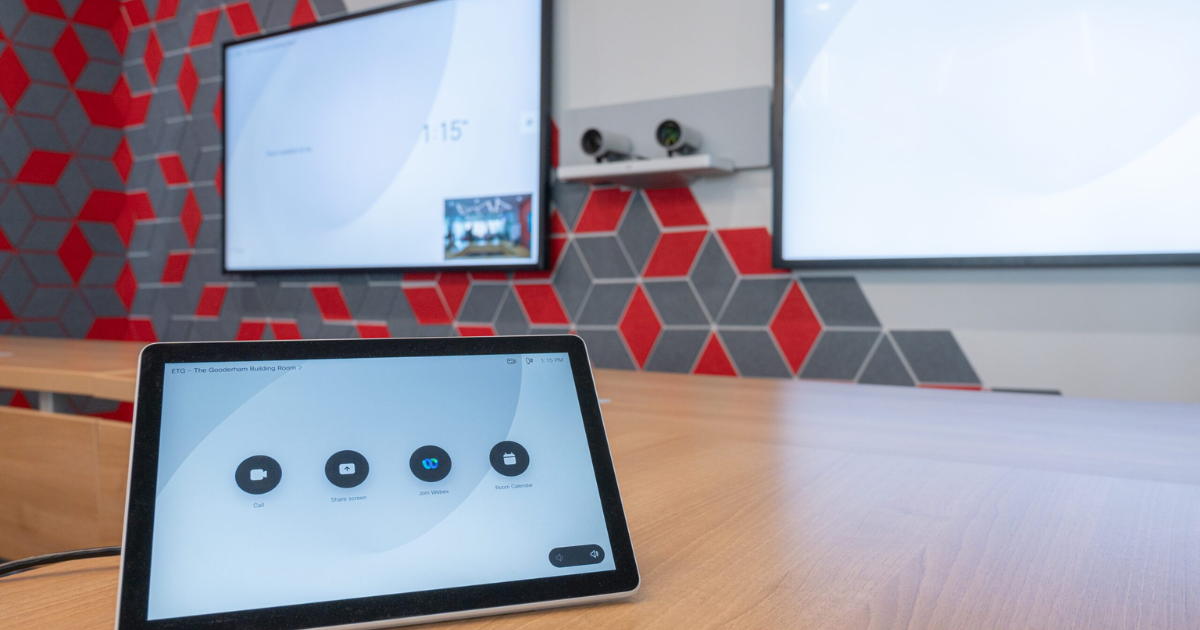
Walk into a well-configured conference room in a modern Portland office, tap “Start Meeting” on the touch panel by the door, and the entire room comes to life. The display powers on. The conferencing platform launches. The camera adjusts to frame the table. The audio initializes at the right level. You did not flip a single switch or touch a single input selector. That experience is delivered by an AV control system, working exactly as it should.
Most people who use meeting rooms every day never think about AV control systems. They just notice when the room works and notice even more acutely when it does not. Understanding what AV control systems are and how they work gives IT and facilities leaders the knowledge they need to evaluate proposals, set standards, and make better decisions about the meeting environments they are responsible for.
The Core Architecture of an AV Control System
Every AV control system has three fundamental components: a control processor, a user interface, and the devices being controlled.
The control processor is the brain. It executes the programmed logic that translates a user action into a sequence of device commands. The user interface is the physical touchpoint the user interacts with: typically a touch panel mounted in or near the room, a button panel, or an app-based interface on a mobile device. The controlled devices are every piece of AV and facility equipment the system communicates with: displays, audio processors, cameras, conferencing platforms, lighting, shades, and room booking systems.
How Commands Move Through the System
When a user taps a button on the touch panel, the user interface sends that command to the control processor. The processor checks its programmed logic and issues a sequence of commands to the relevant devices. “Start Meeting” might tell the display to power on, tell the input selector to switch to the conferencing platform, tell the camera to move to its default framing position, tell the audio system to unmute and set the volume to the room’s calibrated level, and tell the conferencing software to join the scheduled meeting automatically.
The AV control system monitors device responses and can react to them intelligently. If a display does not confirm it powered on within the expected timeframe, the system can retry the command, generate an IT alert, or execute a defined fallback behavior.
Control Protocols: How Devices Understand Commands
To learn more about what AV control systems are and how they work, you need to understand control protocols. Different devices speak different control languages. AV control systems communicate with devices using protocols that match what each device understands. RS-232 serial commands are used for many displays and projectors. IP-based control reaches devices over the network. IR signals control legacy consumer equipment. CEC allows HDMI-connected displays to receive commands through the video cable itself. A capable control processor handles multiple protocols simultaneously, which is how one touch panel can control a room full of devices from different manufacturers.
Programming Is Where the Experience Is Built
The hardware in an AV control system is a platform. The experience users have is determined entirely by how the system is programmed. Good programming creates simple, intuitive workflows that eliminate user decisions. Poor programming creates multi-step processes with too many options, mode selections, and manual inputs that confuse users and generate support calls.
Two rooms with identical hardware but different programming will deliver completely different user experiences. This is why AV control system programming is a discipline in its own right, not a step that happens automatically after the hardware is installed.
Ready to Build Control Into Your Rooms?
Know that you know what AV control systems are and how they work; maybe it’s time to invest in an AV system for your commercial office. Projectus designs and programs AV control systems across Portland and Oregon that are built for real users and real meeting environments. Talk with our solution architect about what intelligent control can do for your spaces.