


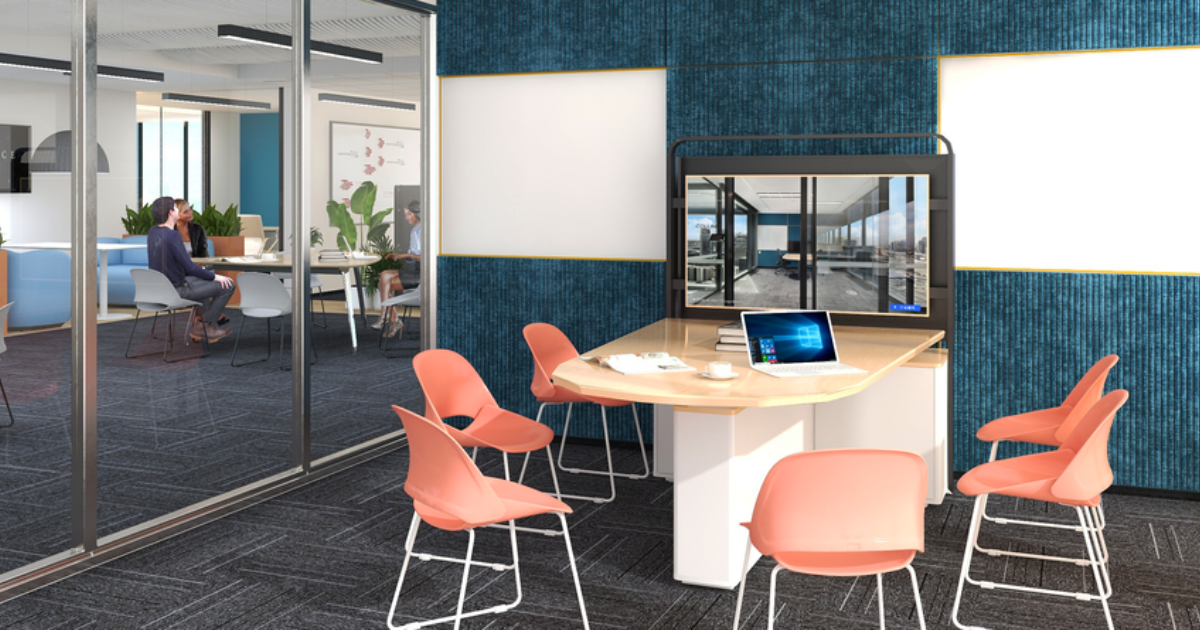
Designing a hybrid meeting room that actually works for both sets of participants is harder than it sounds. Most conference rooms in Portland were designed for in-person meetings. They have a table, some chairs, a display at one end, and maybe a camera on a shelf somewhere. They work reasonably well when everyone is in the room. They fail almost immediately when some participants are remote, and the conversation starts moving around the table.
The standard for a hybrid meeting room is not that it works for the people in the room and tolerates the people on the call. The standard is that it works equally well for both. Every participant, regardless of location, should be able to see the active speaker, hear every voice clearly, and follow the conversation without asking for anything to be repeated. Designing to that standard requires deliberate choices across every element of the room. Here is how to design better hybrid meeting rooms in Portland
Start With the Participant Experience, Not the Hardware
The most important first step in designing a better hybrid meeting room is defining what success looks like from both sets of participants’ perspectives. What does the remote participant need to feel genuinely present in the meeting? What does the in-room participant need to interact naturally with both their colleagues at the table and the people on the call?
These questions surface requirements that hardware selection alone cannot answer. They address room layout, camera placement, microphone coverage, display positioning, and the control experience that determines whether any user can start the meeting without help.
Camera Design for the Hybrid Participant
In a properly designed hybrid meeting room, the camera serves the remote participant, not the presenter. The remote participant needs to see who is speaking, not just a static wide shot of an empty portion of the table. Cameras with auto-framing and speaker-tracking intelligence make this possible: they detect who is speaking and adjust framing dynamically so remote participants stay visually connected to the conversation throughout the meeting.
Camera placement matters equally. A camera mounted above the display at the front of a long table frames the end of the table well and frames the far end poorly. For hybrid meeting rooms where conversation happens across the table, consider dual-camera setups or cameras positioned to capture the full seating area from a consistent angle.
Audio That Serves Every Seat
To design a hybrid meeting room in Portland commercial spaces, one thing you should never forget is audio. In a hybrid meeting room, audio failure is the fastest way to exclude remote participants. When some participants are clearly audible and others are not, remote attendees tune out because following the conversation requires too much effort. Every seat needs to fall within the microphone system’s effective pickup zone.
For Portland’s larger meeting rooms, ceiling microphone arrays are the most effective solution. They provide wide pickup coverage without requiring participants to position themselves near a device, and they deliver even quality from every seat. In rooms with acoustic challenges, combining appropriate microphone selection with acoustic treatment produces results that microphones alone cannot achieve.
Control That Removes Friction
The best hybrid meeting room design eliminates every decision the user has to make before the meeting starts. One touch. Meeting starts. Platform connects. Camera frames. Audio initializes. No input selection. No source management. No mode switching.
This level of simplicity requires deliberate control system programming, not just good hardware. The control system must be programmed around the actual use cases of the room, not the full feature set of the hardware.
Display Placement for the Hybrid Experience
Portland’s hybrid meeting rooms benefit from displays that show both the meeting content and the remote participant gallery simultaneously. Secondary displays or split-screen configurations allow in-room participants to maintain visual contact with remote attendees while following shared content. This keeps the hybrid meeting feeling connected rather than divided.
Design Your Portland Rooms for Everyone
Now that you know how to design a hybrid meeting room in Portland commercial spaces, the only thing you need is someone who can turn your ideas into reality. Projectus designs hybrid meeting rooms across Portland and Vancouver, built to deliver a consistent, equitable experience for every participant. Talk with our team about how to bring this standard to your spaces.